
If you have spent any time researching how to support your child through Key Stages 1, 2, or 3, you have likely come across the term Occupational Therapy (OT). While traditionally associated with physical rehabilitation or adult healthcare, OT is increasingly being recognised by educators and parents alike as a vital bridge to academic success.
When a child struggles to keep up in the classroom, our minds often jump straight to academic tutoring. However, if a child is finding it hard to physically write, sit still, or focus, the barrier might not be their academic capability—it might be their underlying foundational skills.
What is Paediatric Occupational Therapy and how can it connect directly with school performance?
To understand OT, it helps to look at the word “occupation.” For adults, an occupation is a job. For children aged 4 to 13, their “occupations” are the essential activities that fill their daily lives:
- Learning and school life (holding a pencil, organising a school bag, following a timetable)
- Self-care (buttoning a school uniform, tying shoelaces, using cutlery)
- Play and social participation (navigating playground games, sharing, and making friends)
Paediatric occupational therapists are regulated health professionals who look at a child holistically. Their goal is to ensure that a child can fully participate in these daily activities, removing the physical, sensory, or cognitive barriers that might be holding them back.
The Building Blocks of Classroom Success
OT does not teach academic subjects like maths or English. Instead, it addresses the essential, underlying developmental skills that make learning possible.
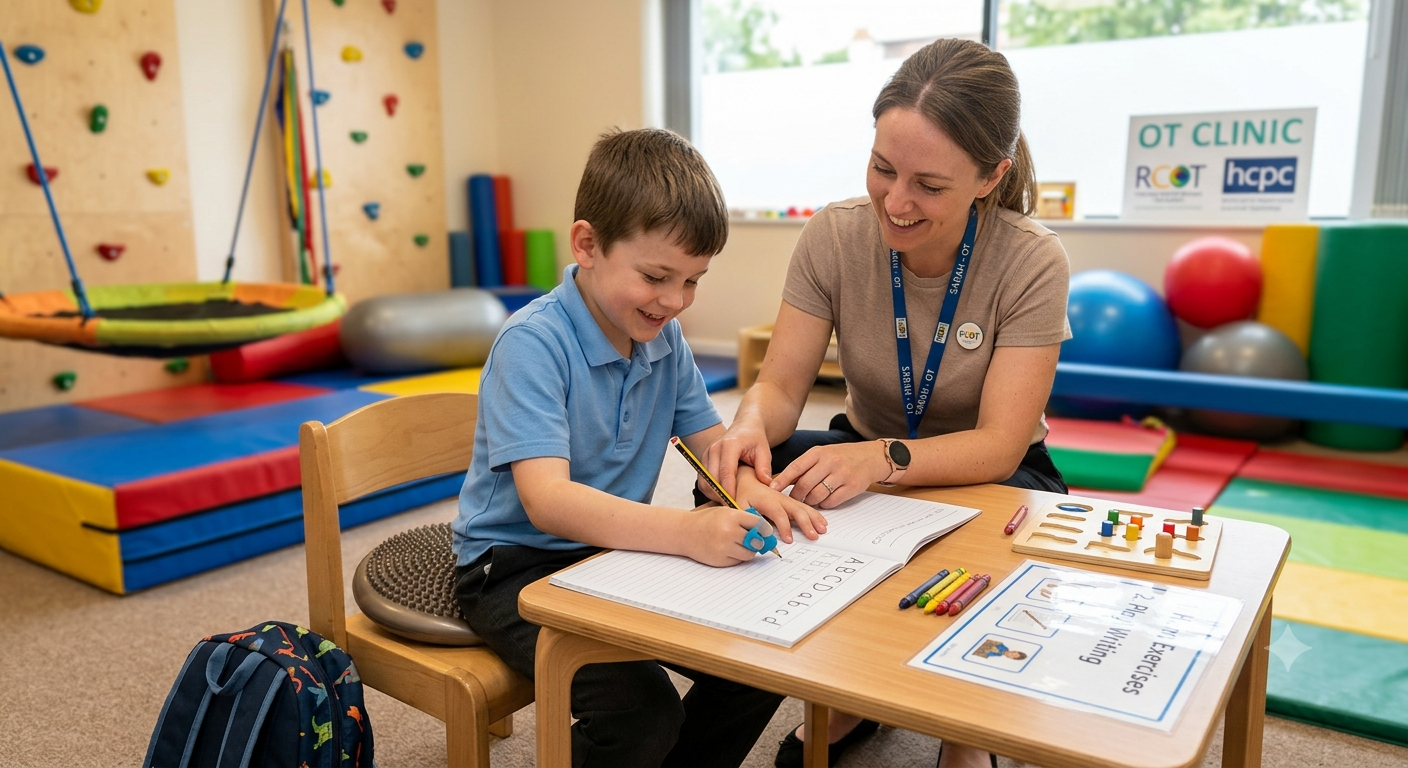
1. Fine Motor Control and Handwriting
Handwriting requires a complex coordination of small muscles in the hand and wrist. An OT looks at a child’s pencil grip, hand strength, and dexterity to ensure they can write fluently without becoming fatigued or frustrated during a lesson.
2. Visual-Motor Integration
This is the brain’s ability to coordinate what the eyes see with what the hands do. It is the skill required to copy text from a classroom whiteboard into an exercise book, catch a ball in PE, or line up columns of numbers in maths.
3. Sensory Processing and Regulation
Children receive a constant stream of sensory information from their environment—bright classroom lights, the scratch of a school uniform tag, or the background chatter of thirty classmates. OTs help children manage this input so their nervous system stays calm, focused, and ready to learn.
4. Executive Function and Organisation
As children transition from Key Stage 1 into Key Stage 2 and 3, the demands on their executive function skyrocket. This includes planning, organising tasks, managing time, and working memory. An OT can help a child learn how to structure a homework assignment or remember their PE kit.
5. Attention, Self-Regulation, and Participation
Staying seated and focusing on a teacher for an hour requires significant physical and mental effort. OT interventions help children develop self-regulation strategies, enabling them to transition smoothly between activities and actively participate in school life.
What Does the Evidence Say?
Occupational therapy is an evidence-based profession, but the strength of data varies depending on the specific intervention.
According to a major systematic review published in the American Journal of Occupational Therapy (AJOT) by Hahn-Markowitz et al. (2020), the evidence for OT’s effectiveness is nuanced:
- Strong Evidence: The research shows clear, robust support for targeted handwriting interventions and direct therapeutic practice. If a child is struggling with fine motor mechanics, OT has a proven track record of creating measurable improvement.
- Moderate Evidence: There is moderate, emerging evidence supporting OT interventions aimed at broader literacy participation, peer-supported reading, and parent-mediated strategies.
- Evolving Evidence: While a separate study published in the Journal of Occupational Therapy, Schools, & Early Intervention (2023) highlights positive outcomes for social interaction and cognitive process skills in school settings, larger studies are ongoing to firmly establish how sensory and behavioral OT approaches translate directly into long-term academic attainment scores, such as those monitored by the Education Endowment Foundation (EEF) in the UK.
Ultimately, the consensus across professional bodies like the Royal College of Occupational Therapists (RCOT) suggests occupation-based interventions significantly improve a child’s confidence, school engagement, and overall well-being.
Observable Differences a Parent Might Notice
Every child develops at their own pace, and a temporary struggle is entirely normal. Rather than looking for signs of a medical diagnosis, you might simply want to explore additional practical support if you notice persistent patterns of the following in their daily school routine:
| Area of Concern | What It Might Look Like in Practice |
| Physical & Motor | An awkward or painful pencil grip, quickly tiring when writing, heavy leaning on the desk, or noticeable clumsiness during physical activities. |
| Sensory & Emotional | Becoming highly distressed by loud noises or crowded school halls; frequent emotional burnout or exhaustion directly after the school day. |
| Organisation & Task | Consistently losing school equipment, struggling to follow multi-step instructions, or extreme difficulty transitioning from playtime back to lessons. |
Who Might Benefit?
Occupational therapy is highly relevant for children who navigate learning with specific Special Educational Needs and Disabilities (SEND), such as ADHD, Autism Spectrum Condition (ASC), and Dyspraxia (Developmental Coordination Disorder or DCD).
However, a formal diagnosis is not a prerequisite for OT. Any child who is hitting a developmental roadblock that interferes with their ability to learn, participate, or feel confident at school can benefit from the practical, targeted strategies an occupational therapist provides.
How to Access Occupational Therapy in the UK
If you feel your child would benefit from an expert assessment, there are two primary pathways in the UK:
- The NHS Route: You can speak to your GP or your child’s school Special Educational Needs Co-ordinator (SENCO). They can submit a referral to local NHS paediatric therapy services. While this route is free, please be aware that waiting times can vary significantly depending on your local education authority and trust.
- The Private/Independent Route: Many parents choose to see an independent paediatric OT to access support more quickly. If choosing this route, it is vital to ensure the practitioner is registered with the Health and Care Professions Council (HCPC) and ideally a member of the Royal College of Occupational Therapists (RCOT).
If you recognise some of these challenges in your child, the best first step is always to seek a professional, formal assessment from a qualified healthcare practitioner rather than attempting to self-diagnose from online articles. At Kosmos Balance, we are not medically trained, and the guidance in this blog is intended for general educational advice and informational purposes only. Our role is simply to help make the search for support easier.
Disclaimer: Kosmos Balance is a membership directory, not a medical or clinical organisation. The information in this article does not constitute medical advice, diagnosis, or treatment. Always seek the advice of a qualified health professional, such as a GP or a registered Occupational Therapist, with any questions you may have regarding a child’s health or development.
-
More Than Just Tutoring: Is Occupational Therapy the Missing Piece in Your Child’s Learning?
If you have spent any time researching how to support your child through Key Stages…

-
Retained Reflexes and Learning
If your child struggles with handwriting, can’t seem to sit still, or finds reading harder…
-
How Private Tutoring Enhances a Traditional School Education
For most parents, the question isn’t “school or tutoring”, it’s how the two can work…